Benjamin Cooper, sentenced to hang for counterfeiting in 1773, reprieved at the gallows and pardoned
Benjamin Cooper 1741–1794 crimetrialcolonial
Benjamin Cooper, born on 13 December 1741, was the fourth of the five known sons of Daniel Cooper Sr, and he grew up on the edge of New Jersey's iron country. As a young man he went into the iron business at Hibernia, in Morris County. On 28 October 1765 he bought from the ironmaster Samuel Ford and his wife Grace a one-third share of five ten-acre lots beside the Horse Pound iron mine, paying £266 13s. 4d., very roughly $58,000 in today's money [K.9]. A fellow investor, James Anderson, bought the same amount [I.79]. Two years later a man who called himself Lord Stirling bought a third share of the works [I.261].
Lord Stirling
Lord Stirling was William Alexander, who claimed a Scottish earldom. In Scotland a jury had found him "the nearest male-heir to the last Earl of Stirling" [I.260]. The court clerks of Morris and Hunterdon wrote him down both as the Earl of Stirling, his formal title, and as Lord Stirling, the usual way of referring to an earl [I.260] [A.181] [I.113].
Stirling looked to iron to make his fortune [I.261]. By 1768 the business at Hibernia was spoken of as "Benjamin Cooper & Co.", with Lord Stirling understood to be the Company [I.79]. Benjamin was the working partner: the governor later described him as "a Partner" in the Hibernia Company and its "chief Manager and Cash-keeper" [I.264].
The business fails
A furnace was expensive to run: streams to dam, timber to cut, workers to house, feed and pay. Stirling's biographer finds him soon in debt to his supplier, and owing thousands of pounds by 1771, because the works produced too little and iron sold too cheaply [I.261]. It was a hard time to sell iron. The colonies were making far more of it than before (American output tripled between 1750 and 1775), the years 1765 to 1767 and 1771 brought a depression in the American market, and bar iron rolled in Britain by newer methods was cheaper than anything colonial works could make [I.262]. At the March 1771 term of the Morris County court, Stirling's supplier obtained a court order to collect what "Benjm Cooper & Co" owed him, and the sheriff reported that he had seized the land in Pequannock Township "whereon the Defd Benjamin Cooper now lives", with the Hibernia Furnace, and that it "remains unsold in his hands for want of buyers"; another creditor, Joseph Self, had a prior suit against him [I.113].
Samuel Ford
Samuel Ford, the ironmaster who had sold Benjamin his stake at Hibernia, was an Englishman by birth who had married and settled in New Jersey [I.260]. He had a past. In New York he had once been arrested for passing forged New Jersey bills of credit and let out on bail, and nothing more came of it. He then set up a "manufactory" for counterfeit money "in a secluded spot near Hanover, in the County of Morris", and with a partner, Joseph Richardson, travelled to Dublin, where "the art of counterfeiting had been brought to great perfection", and on to London to learn more [I.260]. His press was hidden in an almost impenetrable swamp, where the water was half a leg deep most of the year and a man had to crawl on his belly to reach it. His New Jersey and Pennsylvania bills were good enough to pass the inspection of the provincial treasurers themselves, and he was called "the Treasurer for the three provinces" [M.32]. He had no visible living but a neglected farm, yet he always had money, and he had "art enough to persuade several individuals of respectable connections in New Jersey, to aid in the circulation of his spurious currency" [I.260].
Benjamin knew of Ford's interest in bad money early. In 1767, he later swore, Ford went to see a man named Coon at Stony Hill, who had counterfeit New York and New Jersey bills and a copper plate for printing them. Benjamin's brother John brought about forty pounds of Coon's money to a meeting at Thomas Kinney's, where Ford, Benjamin and others looked it over and "all disliked it, being very bad", and in the end they sent it back. John confirmed the story before the grand jury: the bills, he said, "were good for nothing" [I.264].
Ford was suspected of something bigger. In July 1768 Stephen Skinner, treasurer of the eastern division of the province, had reported that the iron chest in which he kept the public money, the treasury at Amboy, had been robbed of more than six thousand pounds [I.260] [M.32], very roughly $1.25 million in today's money. The General Assembly, the elected lower house of the province's legislature, blamed the treasurer's negligence, and Skinner, trying to clear his name, came to suspect Samuel Ford [I.260].
The reckoning
In 1771, by his own later account, Benjamin knowingly received thirty or forty pounds of Ford's bad money, all in one week, and burned a second parcel, "conceiving myself wrong" [I.260].
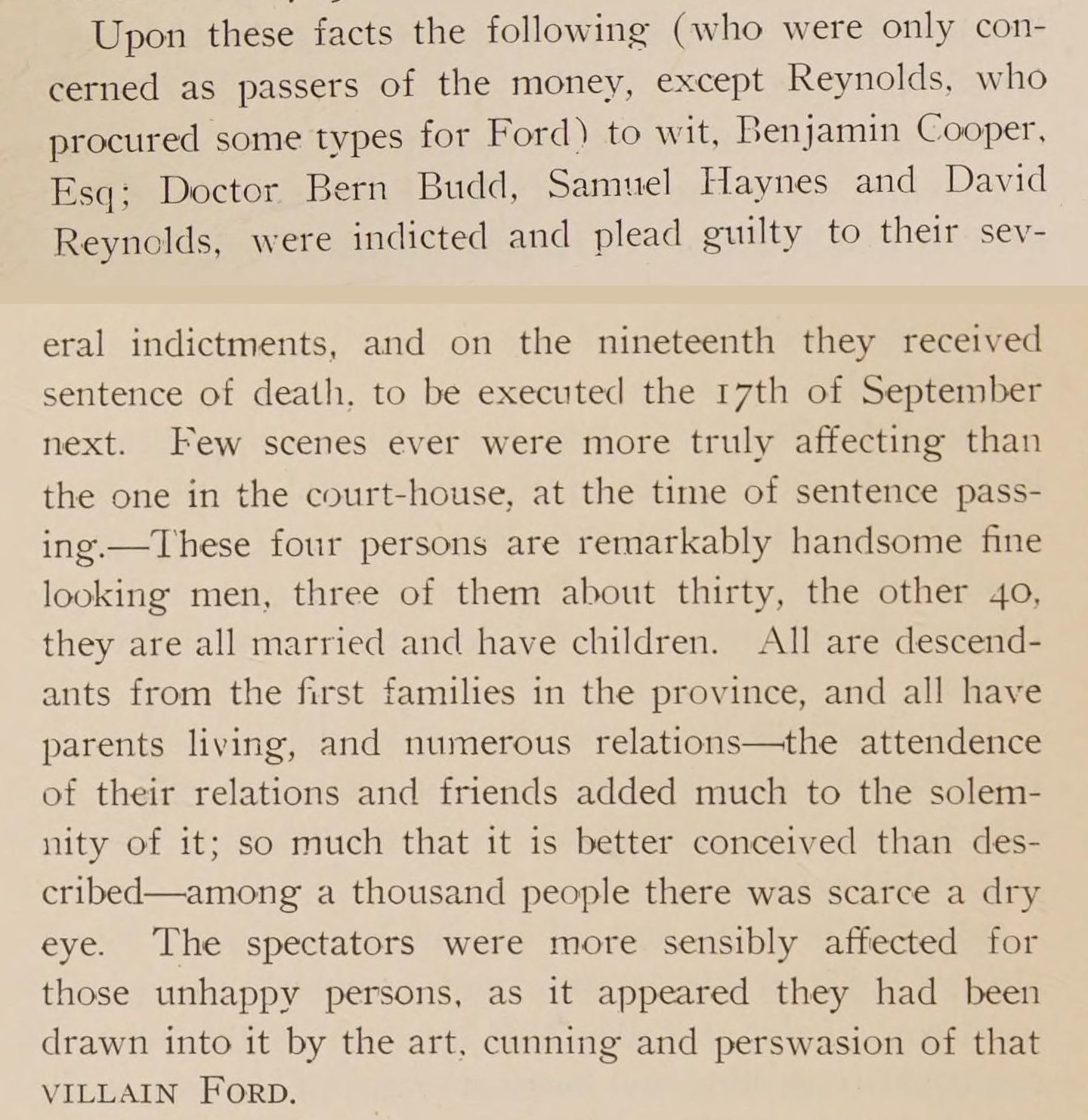
The counterfeiting scheme was uncovered in 1773. On 16 July Ford was arrested and put in the Morris County jail on the green at Morristown, and at about the same time Benjamin and several others were arrested as his accomplices [I.79]. Benjamin was tried at Morristown as a passer of the money, and on 19 August 1773 he was sentenced to death before about a thousand spectators [J.131].
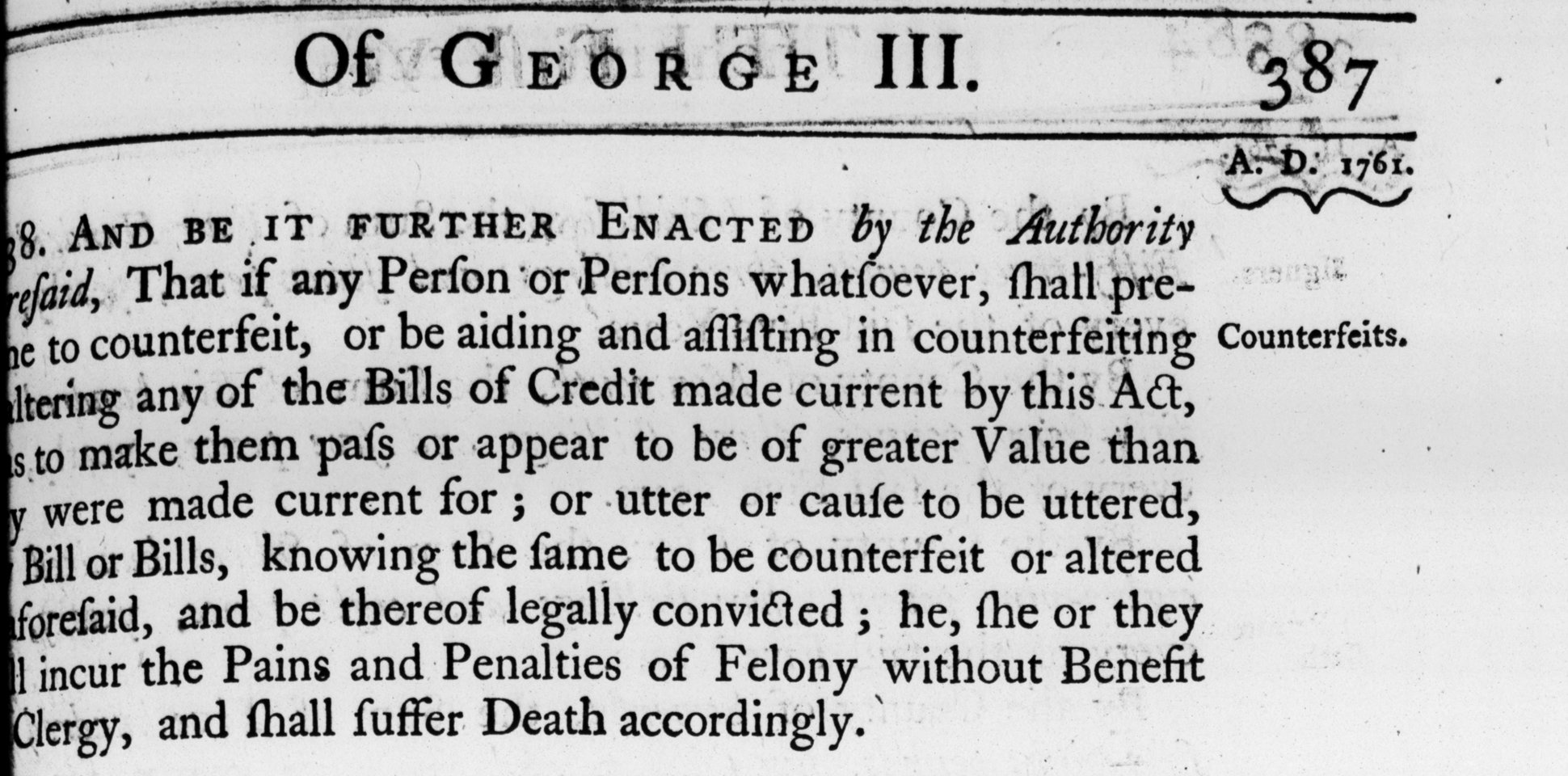
Death was what the law prescribed. A 1761 act specified that passing a bill while knowing it to be counterfeit, which is what Benjamin admitted, was punishable by death "without benefit of clergy" (an appeal for clemency for first-time offenders) [I.263].
A father on the bench
One of the judges who passed that sentence was Benjamin's father [I.79] [I.22]. Daniel Cooper Sr was seventy-eight years old and had sat on the Morris County bench for thirty-four years, since he was named one of the county's first justices in 1739 [I.95], and as a judge of its court since 1768 [M.24]. It is the part of the story the family never forgot: a county historical journal said in 1912 that Judge Cooper was known for his long life, for his six wives, "and also from having been one of the Judges who sat on the trial of his son, who was condemned to death" [M.24].
Father and son were already bound in other ways. On 1 March 1773, four and a half months before the arrests, Benjamin had signed a bond to his father, a sealed promise to repay him £1,118 [A.81]. And it was partly on his father's word that Benjamin had first talked. "Two of the Judges, one of which was my father," he wrote, "promised me I should never have it mentioned further than as an evidence, if I would give a narration of such as was concerned in counterfeiting and passing." "On these promises I gave the account." He was indicted all the same [I.260].
The gallows
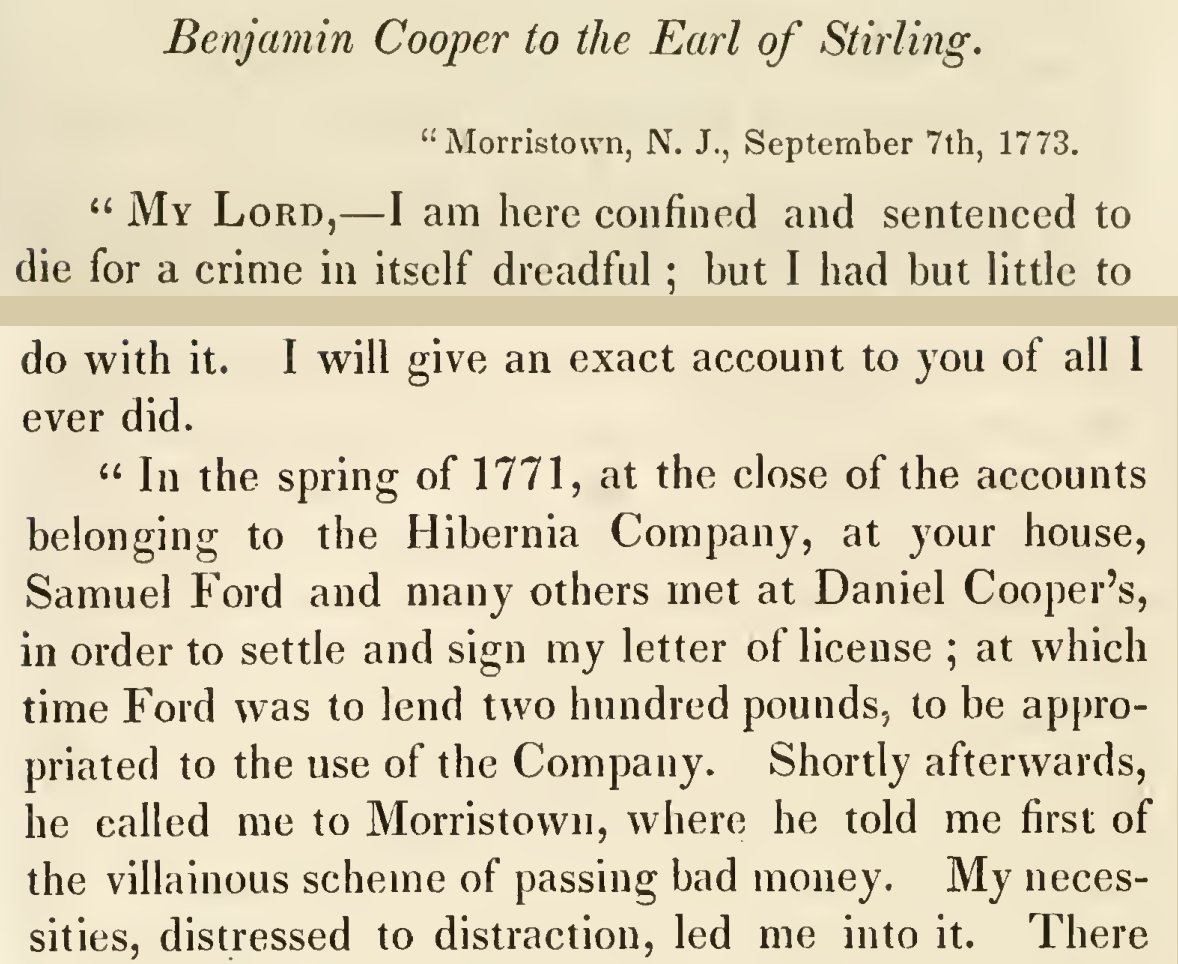
On 7 September, ten days before the day set for the executions, he wrote from the jail to Lord Stirling, telling him how Ford had drawn him in and begging "your Lordship's interest and influence with the Governor and Council for me" [I.260].
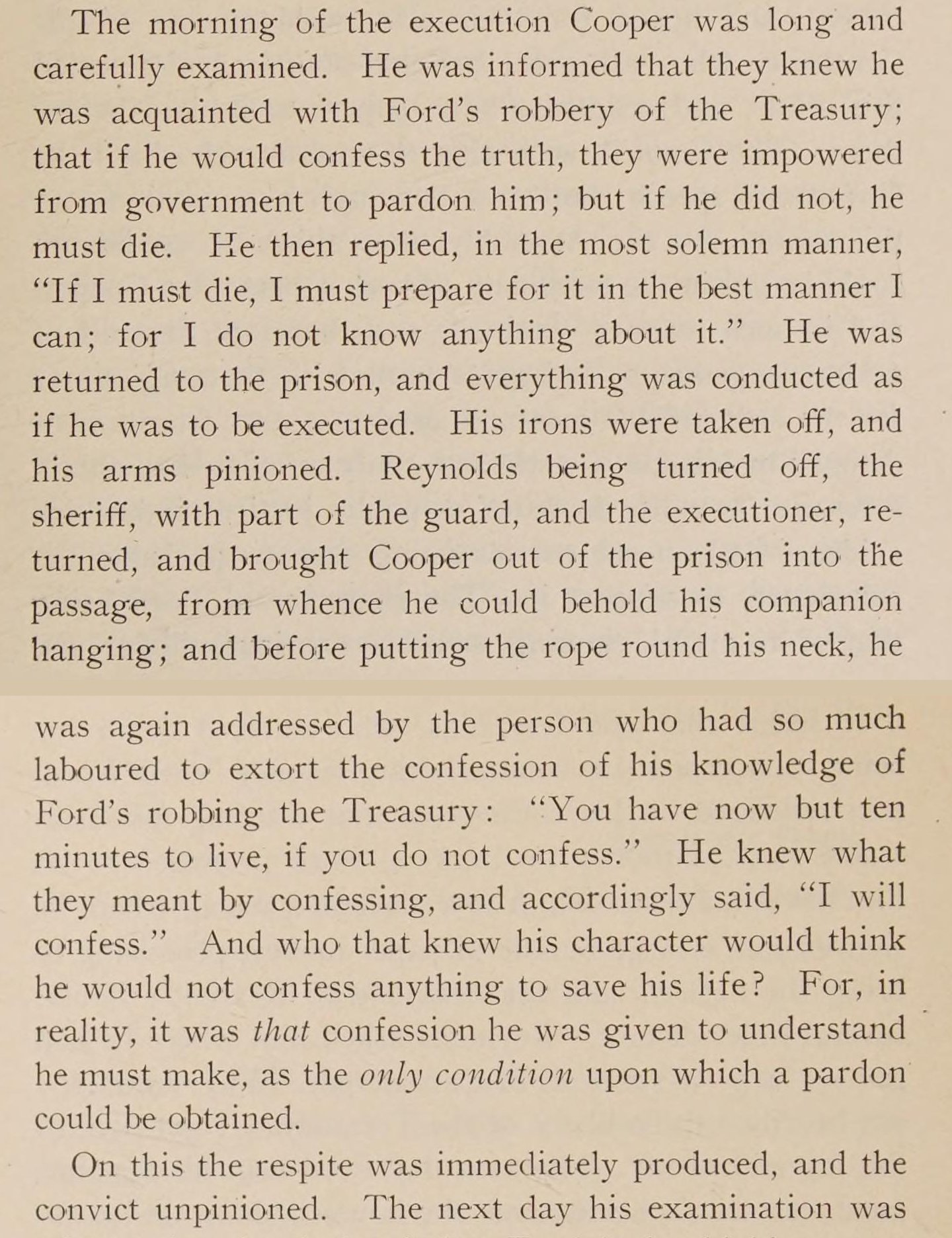
On 17 September his confederate David Reynolds was hanged [M.32].
What the authorities wanted from Benjamin was evidence that Ford had robbed the treasury. On the morning of the execution he was "long and carefully examined", and told that he would be pardoned if he confessed what he knew of the robbery, and that otherwise he must die. He had sworn again and again that Ford had never told him anything about it [M.32].
The next day, examined again, he swore that Ford had told him all about the robbery in the fall of 1768, when the two men met at a New York lodging house: Ford, helped by two soldiers (sergeants, he believed, from the barracks at Amboy) had committed it, and he promised Benjamin some of the money once "the chief Noise was over" [I.260] [J.132] [M.32] [I.264].
The confession did not convince everyone. His first confession had said nothing about the robbery [I.260], and that very morning he had said he knew nothing and would prepare to die. Only with Reynolds hanging in front of him, and ten minutes to live, did he remember Ford's account, the two soldiers and his own 300 pounds [M.32].
The General Assembly concluded that "no confidence could be put in the testimony of such a person as Cooper, and in such manner obtained". It found fault with the magistrates for "the unjustifiable measures used to extort from a condemned malefactor a confession, only calculated to obtain a respite for a life forfeited to public justice"; the evidence, it said, had "no one corroborating fact, or probable circumstance, to support it" [M.32]. Lord Stirling complained to the Council that two of the judges had acted "in an unfair and partial manner" in taking the examinations of witnesses [I.79]. The Assembly's committee went further still: it cleared Ford of the robbery and charged the treasurer himself with it, and the Assembly adopted its report [I.260].
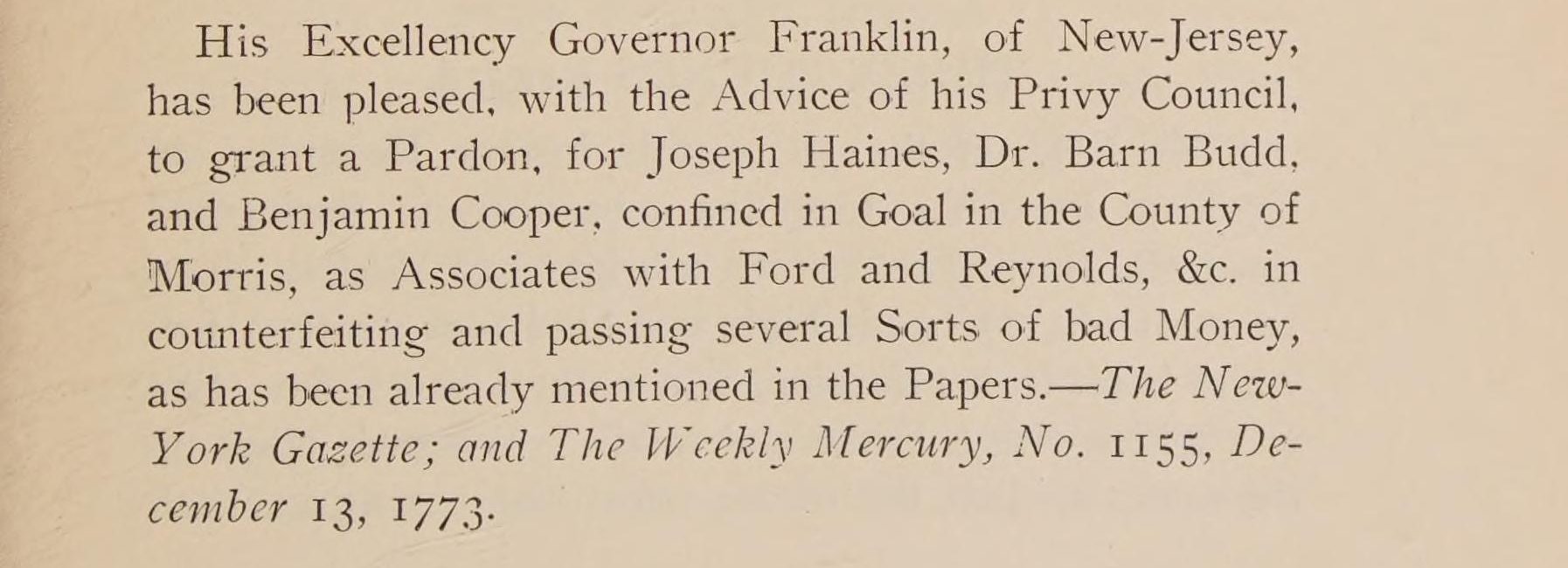
Governor William Franklin had his own reasons to want the confession believed. He had been much criticised for not recovering the stolen money, and since the Stamp Act crisis a majority of the Assembly had been against him; in the treasury affair, his biographer says, "the opposition members put forth their whole strength against him". The treasurer, Stephen Skinner, was on the governor's side, and Franklin later appointed him to his Council [I.260]. Franklin pressed the confession on the Assembly as clearing the treasurer [I.260]. On 13 December 1773, on the advice of his Council and the interposition of Lord Stirling, he issued Benjamin a royal pardon [M.52] [J.134] [I.260].
The Revolution
When the war came, Benjamin served as a militia captain. By 1778 he was living in Lebanon Township, Hunterdon County [D.455], and a Captain Benjamin Cooper of the Hunterdon militia, almost certainly the same man, led two one-month tours in 1776 as captain in the 4th Regiment, attached to Colonel Frelinghuysen's regiment from Somerset [B.2] [B.2a]. On another tour, one of his men later remembered, his company marched to Elizabethtown Point, skirmished with Tories on Staten Island and took three prisoners, and lost a Captain Locke, "shot by the Tories" [B.34].
Afterwards
The debts outlasted the pardon, and the largest was owed to his father. Daniel Sr had lent the Hibernia partners money and wanted it repaid [I.261], and Benjamin's bond of 1 March 1773 promised him £1,118 [A.81]. In 1783, with the debt still unpaid, his father sued on the bond and won judgment for £2,236, double the debt, which was the penalty an unpaid bond carried, and had the sheriff seize Benjamin's plantation of more than 400 acres in Lebanon Township; it was advertised for sale on 21 April 1784, with his beds, books, horses, cattle, sheep and hogs [A.177] [J.9].
Daniel Sr's will lists the rest of Benjamin's obligations that his father had stood security for, among them the costs of the supplier's suit and a bond "for my Said Son Benjamin Cooper's Fines", and makes Benjamin's share of the estate depend on his producing those bonds cancelled [A.8]. Benjamin died in December 1794, about five months before his father, and the account of his estate shows debts and nothing left over [A.4]. A month later, in January 1795, Daniel Sr deeded the plantation "whereon Benjamin Cooper formerly lived" to John H. Cooper of Lebanon, very probably Benjamin's son [K.46].
Sources: I.264, I.95, I.260, B.2, B.2a, B.3a, B.34, D.455, A.81, A.177, J.9, K.46, I.261, I.262, I.263, K.9, I.79, K.36, K.38, A.181, I.110, I.113, A.8, M.32, J.131, I.22, M.24, J.132, M.52, J.134, A.4