The Cooper family burying ground at Long Hill, and the long journey of its seven stones
Daniel Cooper Jr 1729–1787 · Nancy (Cross) Cooper 1737–1803 · John Cooper 1738–1778 · Stephen Cooper 1767–1844 · Daniel Cooper Sr 1695–1795 placescemeteries
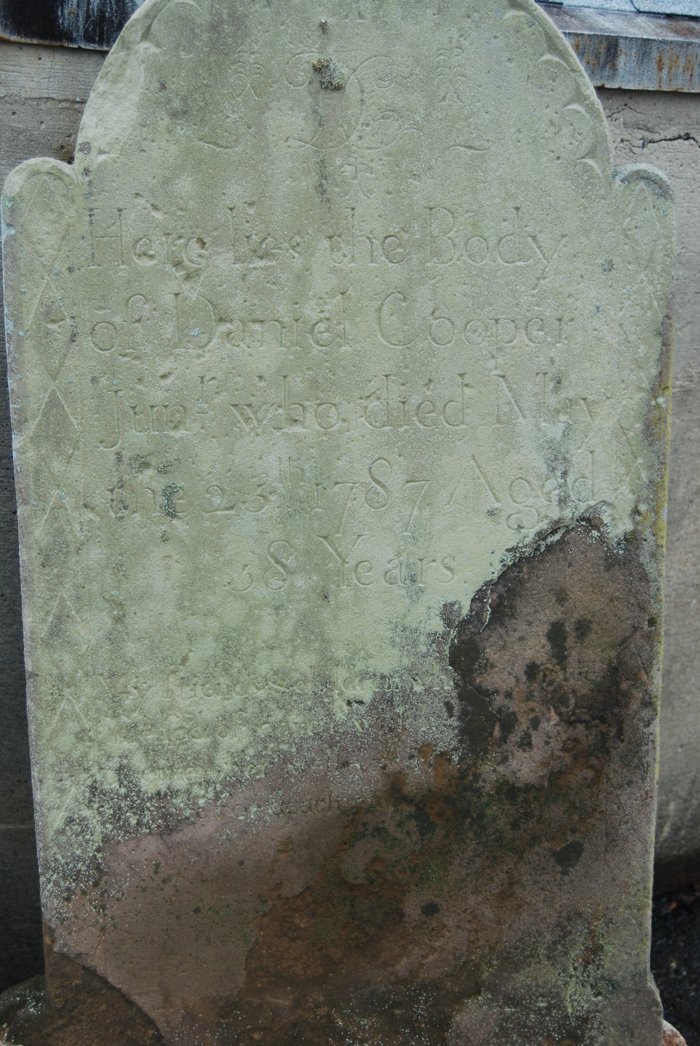
On 12 June 1787 the Brunswick Gazette reported that Daniel Cooper Jr, of Long Hill in Morris County, had taken his own life in his barn after about two months "in a delirium". He "was interred on the Sunday following in the family burying ground on his father's plantation", with a sermon by the Rev. Samuel Kennedy "before a multitude of six or seven hundred persons" [I.57]. His father, Daniel Cooper Sr, was then over ninety. Daniel Sr himself was buried eight years later in the Presbyterian churchyard at Basking Ridge [G.27]; his son lay in the family's own ground at home.
Who lay there
Nobody knows how many people were buried in the Cooper ground. Seven stones survive [G.4]:
| Stone | Died |
|---|---|
| John Cooper, Daniel Jr's brother | 31 March 1778, aged 46 |
| Daniel Cooper Jr | 23 May 1787 |
| Anna, wife of Daniel Cooper Jr | 7 May 1803, aged 68 |
| Peter Layten | 2 April 1804, "in the 71 year of his age" |
| Jeremiah Mott | 9 September 1813 |
| [?]anny M. Cooper, a daughter of John G. and Elianor M. Cooper | 26 January 1821, aged 3 |
| Stephen Cooper, Daniel Jr's son | (lower inscription illegible) |
There were at least two more. A county inventory of burial grounds records that Elias Coriell and his wife Sarah "were once buried here", and that a descendant later moved their stones to the West Millington Baptist churchyard [G.729]. The same inventory calls Peter Layton a Revolutionary War soldier, "possibly the only Revolutionare War soldier buried in Passaic Twp." [G.729].
A backyard
In time the Coopers moved away [J.618], and the land passed to other owners. By 1847 the ground was being written into the deeds of the land around it: a deed of that year mentions the graveyard in its description of the property, and a deed of 1926 sets aside "a certain old Grave-Yard" from the land it sells [J.119]. In 1956 the lot, by then 417 Chestnut Street in Stirling, was sold "subject to any outstanding rights for burial purposes in a portion of said described tract", words repeated in the deed of 2003 [J.119] [K.138].
The county's inventory found the place "now extinct": "No traces of stones. Plot is heavily overgrown and used for disposal of trash" [G.729]. The stones that were left were being broken, thrown into the street, or carried off [J.618].
Seven stones on the move
In 1976 the township historian, on the mayor's advice and with the owner's permission, took the seven remaining stones away for safekeeping. They were set in concrete in front of the public library on Central Avenue in Stirling [J.614] [J.618]. The inventory gives a different account, saying the stones went first to the township's sewer department building [G.729].
When the old library was given up in 2003 or 2004, the stones were moved again, "temporarily", to the yard of the Department of Public Works, a parking lot where they leaned against a building [G.730] [J.618] [J.615]. They were still there five years later [J.614].
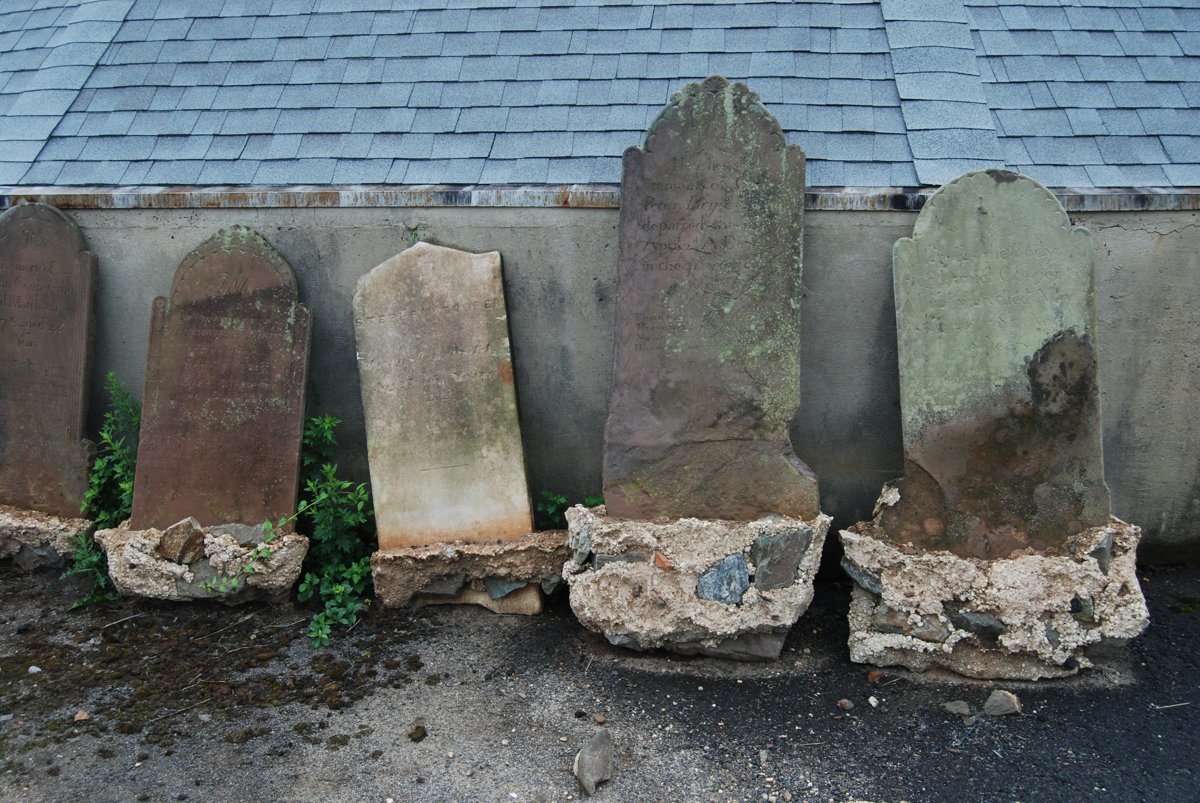
In 2008 the mayor asked the township's Historical Advisory Committee whether the stones should be preserved, how, and where they could be placed "to maximize their visibility and enjoyment by Town residents" [J.613]. That autumn a local Boy Scout proposed finding them a permanent home as his Eagle Scout project [J.615]. The township's attorney asked a title company to find the old deed describing the burial rights on Chestnut Street [K.138]. In 2013 volunteers scrubbed the stones clean at the public works yard [G.4].
A home in Stirling
In March 2017 an architect drew up the plan: the seven stones on two curved rows around a small paved circle and a plaque, with thyme, rhododendrons and dwarf azaleas, beside the Stirling train station [J.616]. By June 2018 it was built.
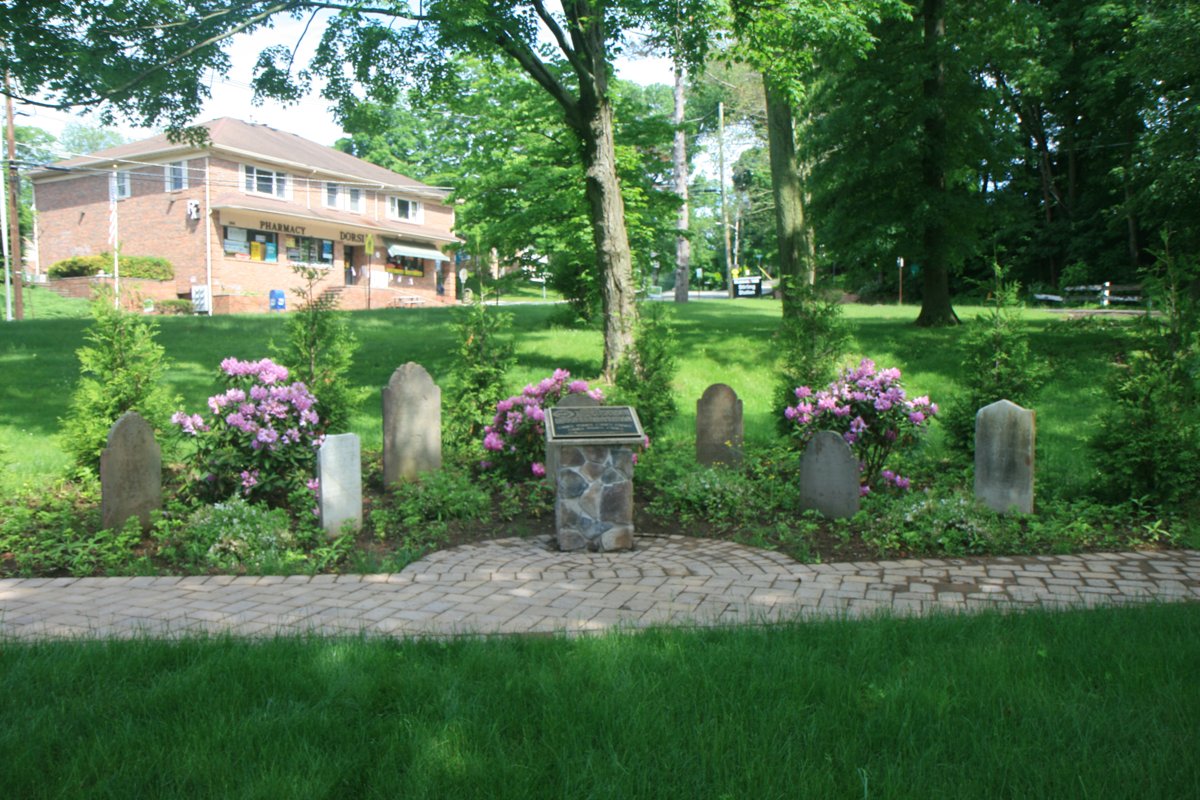
The plaque calls the stones "cenotaphs", markers for people "whose remains are elsewhere" [G.730]. The remains are still where they always were. No record has been found that anyone buried in the Cooper ground was ever moved [J.617], and the deeds to the lot on Chestnut Street still carry its burial rights.
Sources: G.27, I.57, G.4, J.119, G.729, J.618, J.614, J.613, J.615, K.138, J.616, G.730, J.617